Get to know the code
Understand unfamiliar code
with evidence.
Explore how a repository works, follow its call paths, and inspect the source behind each explanation.
No account or API key needed for the example.
Start with a question
Now explore your own repository.
Turn a public GitHub repository into a navigable Wiki with explanations and source references. Keep reading as chapters finish, then return to your saved link.
Want to keep exploring first? Browse ready Wikis →
Take that context to your coding agent.
Build a local index for Claude Code or Codex. Find definitions, follow callers and read the source in your own checkout.
python -m pip install "codenib[graph,mcp]"
codenib codegraph init /path/to/your/repo
Python 3.10+, Git, a clean checkout, and Claude Code or Codex. This shipping CodeGraph path runs locally without a model, API key, or GPU for CodeNib; your agent uses its own model. It is separate from the grep/Jev experiment.
Setup and language prerequisites · Ask your agent to start with explore_context.
Evidence you can inspect. Tools you can compare.
Follow source locations, check language coverage, and reproduce the retrieval methods.
Follow definitions and calls
Bounded context and typed SCIP/LSP graphs help your agent navigate from a question to the source. Compare the fit with grep, Serena, CodeGraph, and DeepWiki.
Compare repository tools →Know your language's support
14 language entries, 12 with graph backends. See which providers, prerequisites, and capabilities apply to your repository.
Open the language matrix →Reproduce the methods
Pinned LocAgent, Agentless, CoSIL, OrcaLoca, and RepoNavigator contracts. Dataset and scorer checks make the evaluation boundaries visible.
Explore agent integrations →Share a Wiki from your own repository with the existing GitHub Pages workflow.
71.4% code-block Recall@5.
Model-planned grep → Jev on 100 real issues. +12.8 points over the same grep candidates without reranking.
Experimental result · Method and limitations
From the blog
Architecture, benchmark results and deployment guides from the team building CodeNib.
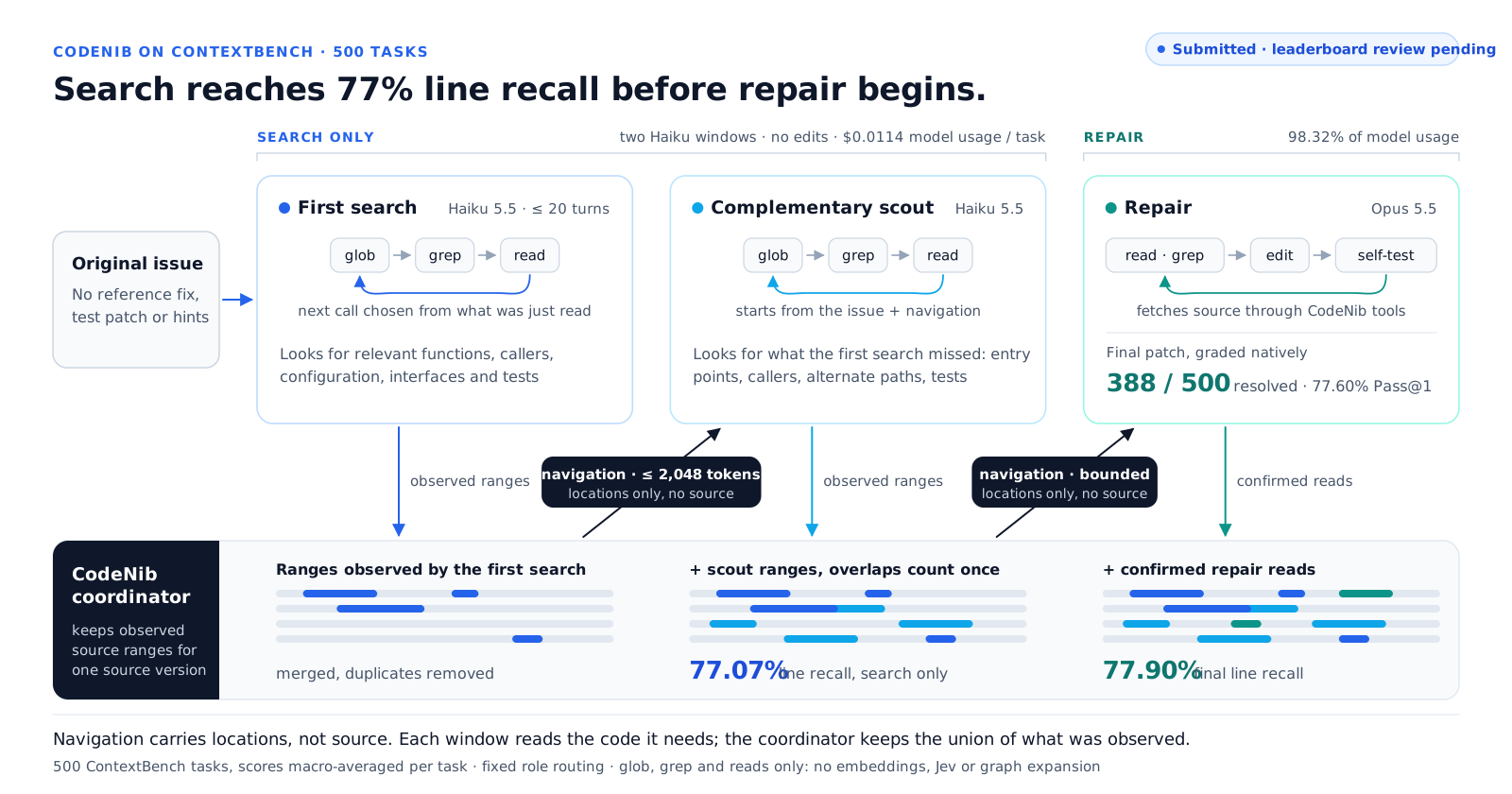
CodeNib on ContextBench: 77% Line Recall Before Repair
Search alone reaches 77.07% line recall. Our complete agent ranks #1 in line recall and Pass@1 on ContextBench's Agent systems leaderboard as of October 23, 2026 (UTC). See how the search and source handoff work.
Read the article →